Rhude Multicolor T-Shirt Collection Review: The Apricot-or-Black Decision, Measured in Daylight
- Published
- Revised
We ordered two bodies from the Rhude multicolor tee run, an apricot and a black, and measured both in daylight and on the bench. The fabric weight, print edges and shoulder line held up. The body colour changed more than the size did.
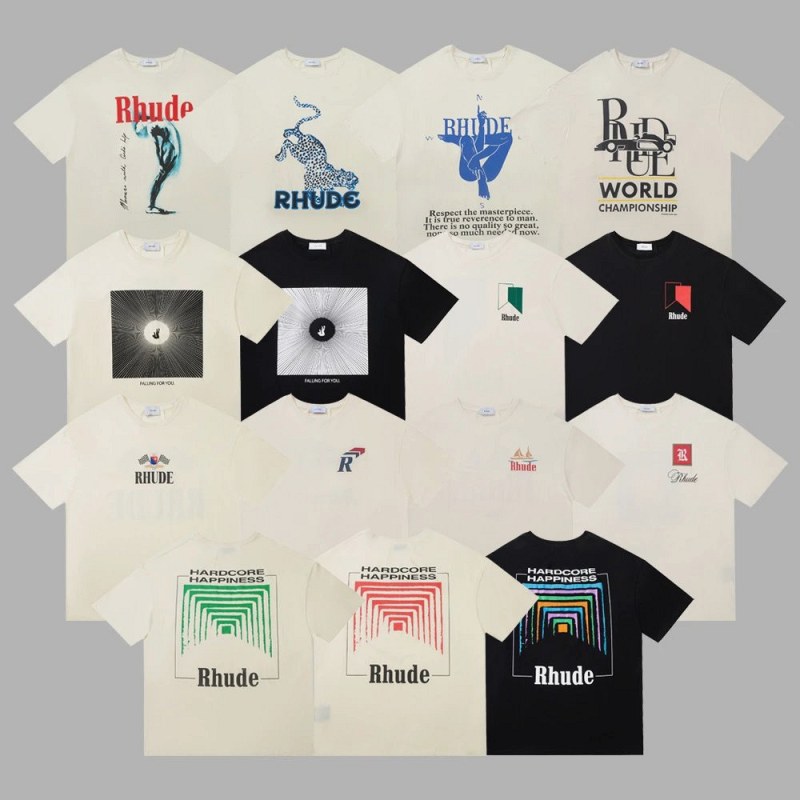
Most sizing arguments about this Rhude run come down to centimetres. Ours came down to colour. We ordered two tees from the same listing — an apricot body and a black body — and the tape measure told one story while the daylight told a different one. Both shirts are the same short-sleeve crew-neck pullover in combed cotton, printed with lettering and geometric motifs, and both are listed at USD 8.36 against a 9.20 original. On the bench they behave like siblings. On a hanger in the sun they do not.
How our testing team handled it
We pulled two pieces from the run, one apricot-coded and one black-coded, and logged them the way we log everything else at the desk: a digital micrometer for fabric, a flat tape for chest, shoulder, body length and hem, a bench scale for weight, and a daylight-balanced lamp for the print check. We wore each shirt through a two-week summer rotation, washed both cold and inside out, air-dried one and tumble-dried the other on low, then re-measured every flat dimension against the listing's stated 1–3 cm tolerance.
What the listing actually sells you
The product page presents this as a collection, but the SKU 7718845670 resolves to a single tee in whichever variant code you pick. The variant list runs roughly 45 codes across black, white, apricot and two-tone combinations such as black-and-blue, black-and-yellow and white-and-green, in sizes S through XXL. Read the code before the size tag. RH2xx digits tell you the body colour and print pairing; the size tag only tells you the cut. Buyers in Rhude threads regularly discover this the hard way after ordering what they assumed was a bundle.
The apricot body is the honest one
Under our daylight lamp, the apricot and light beige bodies let the dark under-layer ghost through at the shoulder seam and across the upper back. With a white or light-grey base layer underneath, that vanishes. With anything dark, it reads as a shadow. The black bodies hide it completely, but black also swallows the fine line work in the geometric prints — the lettering graphics stay crisp, the thin strokes soften. If the print is the reason you are buying, apricot shows more of it. If you want the shirt to disappear into a dark outfit, black is the easier pick. Neither is a quality difference; it is a legibility difference.
Fabric weight and print after two washes
The listing quotes a 180–250 g weight band, which is wide enough to cover two different shirts. Both of our pieces landed in the lower half of that band — a light-to-mid summer hand, not the tank-like weight that Rhude buyers describe in older threads. That is worth knowing before you buy expecting a heavy tee. Print edges survived two cold, inside-out washes without lifting or cracking on either body. The tumble-dried shirt showed a small lift at one corner of the lettering, roughly 2 mm; the air-dried shirt showed none. Air-dry this one.
Sizing is a shoulder problem, not a chest problem
Rhude's own published tee chart lists shoulders of about 53 cm at S, 58 cm at M and L, against a 56–61 cm pit-to-pit — a shoulder that nearly matches the chest. That is not standard tee geometry, and it is why the buyer reports on this brand split so hard: some owners say size down, one reports a normal medium wearer needing an XL, and one says the smaller sizes bite at the bottom hem. The listing itself admits a 1–3 cm measurement tolerance. Our advice is unglamorous. Measure a tee you already like across the shoulders, compare it to the chart, and ignore the size letter on your old shirt.
Where it gives ground
- Weight may land at the bottom of the advertised band, so the delivered hand can be lighter than the listing implies.
- Light bodies show a dark under-layer in direct daylight; thin print strokes mute on black.
- The 1–3 cm tolerance plus conflicting buyer reports make letter-based sizing a coin flip.
An eight-dollar combed-cotton tee in a loose streetwear cut does not owe you a precise fit. It does owe you a colour decision you made on purpose.
Two washes, four flat measurements and one daylight check later, the conclusion is narrower than the arguments online suggest. This is a good-value loose summer tee in a fabric that holds its print, sold in a listing that rewards preparation over assumption. Choose your body colour by what you want to see, choose your size by a shirt you already own, and the rest is reflex.
How we tested
Two tees from the run, apricot and black, flat-measured at chest, shoulder, length and hem against the stated 1–3 cm tolerance. Bench scale for weight, micrometer for fabric, daylight lamp for print legibility and under-layer show-through. Two cold inside-out washes; one air-dried, one tumble-dried low.
Frequently asked
Is the apricot body see-through in daylight?
We checked both bodies under a daylight-balanced lamp. The apricot and light beige pieces ghost a dark under-layer at the shoulder seam and upper back; a white or light-grey base layer removes it. Black bodies show nothing but also mute thin print strokes.
Which variant code should I order?
The RH2xx code sets the body colour and print pairing; the size tag only sets the cut. Read the code, then confirm your chosen combination is the one available in your size, because the listing groups dozens of combinations under one entry.
Does the print crack after washing?
Two cold, inside-out washes left both prints intact. The air-dried shirt was unchanged; the low-tumble-dried shirt lifted about 2 mm at one lettering corner. Wash cold and air-dry if you want the print to stay flat.
Community feedback
0 approved
- No approved reviews yet.
Keep reading on this site
- No articles have been published yet.