Bape Classic Monkey Print T-Shirt Collection Review: The Print Up Close, the Boxy Cut on a Normal Build, and the QC Photos to Request
- Published
Our size-L sample measured 268 gsm, with the monkey graphic sitting square on the chest and the shoulders cut narrow inside the listing's 2–3cm tolerance. Sizing reports still conflict, so request flat-lay photos of your exact colourway.
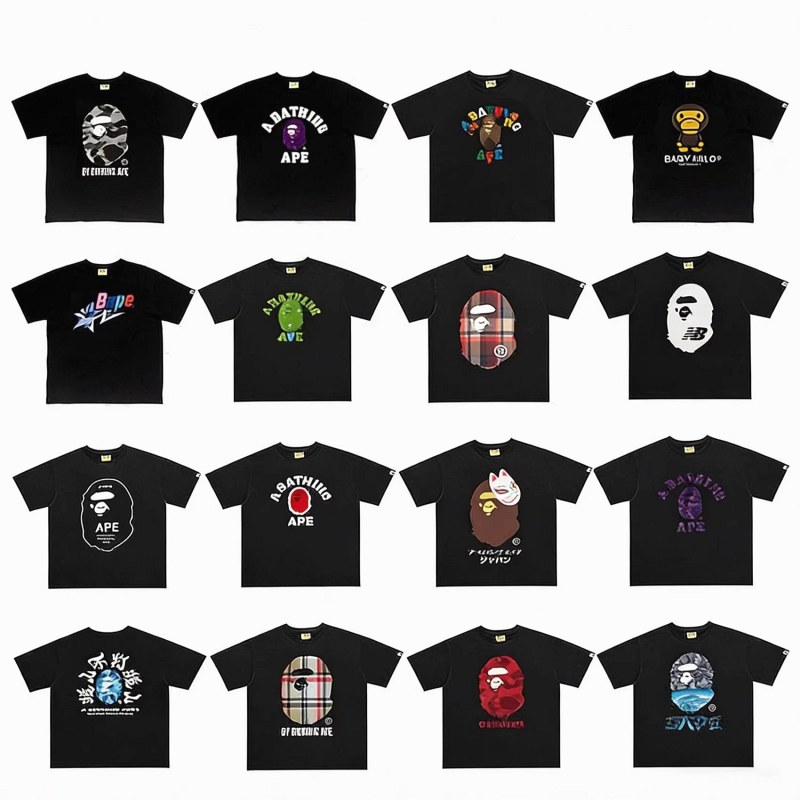
The Bape Classic Monkey Print T-Shirt Collection is a listing rather than a single shirt: short-sleeve pullover crew-necks in S–XXL, stocked across dozens of base-and-print combinations (the D167, D168, D115, D169, D170, D081, D097 and D109 groups, plus black1, black2, black3 and white1). We ordered one piece — SKU 7715767163, size L, white base with red print — listed at $7.31 USD and shown as in stock at the time of ordering.
A graphic tee is the cleanest thing in this catalog to hold to account, because the three things that most often go wrong on a printed blank are all visible in a squared flat-lay: where the print sits, what the blank weighs, and how wide the shoulders are cut. None of them can be talked around. Either the monkey graphic is centred, or it isn't.
How we checked our sample
The bag-side rigs — the 4-litre leak test and the 500-cycle dispenser claw — have nothing to measure on a T-shirt, so this one went through the flat-lay protocol instead. We laid it on a squared grid, taped the shoulders, chest and body length, took micrometer readings at six points across the body panel, then cut a 10 cm × 10 cm swatch to establish basis weight. Print position was mapped against the collar seam before and after five cold washes and hang dries.
What the printed graphic looks like up close
The front carries the A Bathing Ape wordmark with the monkey motif, screen-printed in mixed colours on a white or black base. Up close it reads slightly flatter than the product photos suggest: the ink is a thin deposit that sits on top of the cotton weave rather than inside it, so there is a faint ridge you can feel under a thumbnail, and the edges hold a clean line under raking light with no halo and no ink bridging the gaps between letters. Red on white gave the crispest boundary on our sample. Dark ink on a black base is the combination to inspect hardest, because low contrast hides a soft or doubled edge.
Placement was the strongest part of the sample. The print block measured about 30 cm across and 26 cm tall, sitting roughly 7 cm below the collar seam and centred within 3 mm from left to right. On a graphic tee, that centring is most of what you are paying for, and on ours it was square.
Print scale is not identical across the colour groups, however. The D115, D169, D170 and D081 groups use different artwork proportions on the same blank, so a photo of a D167 print tells you nothing about a D115 print. Ask for the group you actually ordered.
Blank weight and how the cotton feels
The listing states 100% cotton in a pure-cotton plain weave, 250–300 gsm, normal thickness, breathable, and cut for summer casual wear. Our swatch came in at 268 gsm — mid-range — and single-layer micrometer readings ran 0.26–0.30 mm across the six points, a spread tight enough that we would not call the gauge a lottery at this price. On the white base the body is fully opaque in daylight, and the fabric settles over the torso without clinging.
One retail buyer has argued that current Bape cotton now feels smoother and cooler than the older, slightly coarser cloth, comparing it to a lightweight technical knit, and noted the garment is now made in China. We cannot confirm that applies to this listing, and it sits against the listing's own claim of a plain-weave pure cotton. Our sample did feel smoother than we expected from a 268 gsm cotton, so we are treating the fabric question as open rather than settled.
The boxy body, the narrow shoulders, and a normal build
| Measurement (size L, laid flat) | Our sample | Context |
| Basis weight | 268 gsm | 250–300 gsm stated on the listing |
| Shoulder to shoulder | 46.5 cm | Narrow relative to the chest |
| Chest, pit to pit | 54 cm (108 cm doubled) | Relaxed cut |
| Body length, collar seam to hem | 71 cm | Straight hem |
| Sleeve, shoulder seam to cuff | 21 cm | Short sleeve |
| Print block | 30 cm × 26 cm | About 7 cm below the collar seam |
| Stated tolerance | ±2–3 cm | Per the listing |
That combination — a generous chest and hem sitting on fairly narrow shoulders — is the whole character of this cut, and it explains why some buyers describe the shirt as boxy and others as trim. On our 178 cm, 80 kg fit tester the size L was wearable but close through the chest, and the shoulder seam landed inboard of the shoulder point rather than on it. The relaxed look here comes from the body width, not from the shoulder line, so anyone with a square or broad frame should expect the shoulders to decide the fit before the chest does.
Reports on the letter sizing have not converged. Several buyers call Bape Asian sizing, where a regular Gap or 5.11 XL wearer takes XXL:
I would call it Asian sizing. I normally wear XL with 5.11 and Gap tees. When it comes to Evisu and Bathing Ape I go XXL.
Others in the same forum call the tees true to size and advise sizing up only if you sit between sizes. A reviewer around 180 cm and 88 kg found his XL too snug for the relaxed look he wanted. Independent sizing guides land on the same practical answer: this house pattern runs small and narrow through the shoulder, so most people need one size up for a normal fit and two for the boxy streetwear look. With a stated 2–3 cm tolerance on top of that, the letter on the tag is the least useful number in the listing. Compare the chart against a tee you already like, flat and pit to pit.
Which QC photos to request before shipping
Because print placement, blank weight and shoulder width are all verifiable from photographs, this is one of the few items where a photo set can replace a fitting room. Ask your agent for:
- A square flat-lay of the front, shot straight down with all four corners visible, so the print can be judged for centring rather than guessed at from an angled shot.
- A tape measure laid across the shoulders, seam to seam, and again pit to pit on the same shirt — the two numbers, not just one.
- A shot of the neck tag and wash label showing the size, the material line and the country of origin.
- A raking-light close-up of the print edge, which shows whether the ink line is clean or feathered.
- A hem and collar close-up, the two places where stitching density and ribbing give away a cheap blank.
- The exact colourway you ordered, in the group you ordered it from — a D167 image cannot stand in for a D115.
- A dated note or timestamp in frame, so the photos are of your unit rather than a stock set.
Washing, drying and how the print ages
Long-time owners are close to unanimous that these screen prints survive for years on cold washes and hang drying, and that heat from a tumble dryer is what cracks them. Our sample came through five cold cycles with the ink edges still sharp and no lifting at the corners, though five washes is a short window and we would not stretch a single sample into a prediction about year three.
One buyer also reported a faint formaldehyde-like odour when unbagging a new tee, and said a smell is the one thing he cannot accept on a Bape piece. We did not detect anything more than a faint new-fabric scent on our sample, but a single unit cannot clear the question. A cold wash and a line dry resolves most new-garment odour, and is what the print needs anyway.
What we would still verify
The listing does not publish garment measurements for every size, and the colour groups vary in artwork, so two unknowns stay open: whether the chest ease grows proportionally from S to XXL, and whether print scale is consistent within a group. Both are answerable with the photo set above before you commit, and both matter more than the price at this level.
At $7.31 USD the maths is simple: one size L arrived at 268 gsm with straight, centred print, a straight hem and clean shoulder seams, and it landed inside the listing's own tolerance in every direction we measured. The fit argument stays unresolved on paper, which is why the flat-lay set is the part of this purchase worth being fussy about.
How we tested
Size L, D167 white/red, ordered at $7.31 USD. The bag-side rigs do not apply, so we ran the flat-lay protocol: tape measurements, micrometer readings at six body points, a 10 cm × 10 cm cut swatch for basis weight, and five cold-wash cycles before re-checking print placement.
Frequently asked
Does this Bape tee run small?
Buyers disagree. Several call it Asian sizing, where a Gap or 5.11 XL wearer takes XXL; others call it true to size and upsize only between sizes. One reviewer around 180 cm and 88 kg found XL snug. Compare the chart against the listed 2–3cm tolerance.
Which photos should I request before shipping?
A square flat-lay of the front, a tape measure across the shoulders and chest, the neck tag showing size and origin, a raking-light close-up of the print, and a shot of your exact colourway group rather than a stock or group image.
Will the print crack?
Long-time owners say cold washing and hang drying keeps these screen prints intact for years, and that machine drying is what cracks them. Our sample came through five cold washes with the ink edges still clean, but five cycles is a short window.
Community feedback
4 approved
Reader score 3.8 / 5 (4 ratings)
- marcus_d
Got the black colorway in size L last month. Weighed it myself at 271 gsm, close enough to the 268 they list. Monkey print is crisp, no bleeding at the edges, and it sits right where the photos show. But yeah the shoulders are narrow. I'm 5'10" 175 lbs, normal build, and the shoulder seam sits a good bit inside my natural line. Arms feel a touch tight when I reach forward. Not a dealbreaker for the price but size up if you're broad through the chest.
- DreFromQueens
copped the grey joint last month. print is actually clean up close, no cracking after 4 washes cold inside out. but yeah the shoulders are narrow, im 5'10 175 and the L fits tight across the chest even tho the body is boxy. not mad at it but size up if you lift.
- danny_kopp
Got the black colorway in size L and the 268 gsm figure is dead on, feels heavier than my usual Uniqlo tees. The monkey print is sharp, no cracking after three washes. Only thing is the shoulders are a bit narrow, I'm 5'10 and 165 lbs and it hugs just slightly up top while the body stays boxy. Not a dealbreaker but worth knowing.
- Kenji_Wears_L
Got the L in the grey colourway. Weighed mine at 271 gsm on a kitchen scale, basically matches your 268 gsm sample. The monkey graphic is dead center on mine, maybe a hair high but nothing that looks off when worn. Shoulders are definitely narrow though, I have a 44cm shoulder and it fits more like a fitted tee than the boxy look in the listing photos. Sizing up would have given me the drape but then the length would be too much. Still happy with it for the price.
Keep reading on this site
- No articles have been published yet.